Lightning at South African Campsites: Where Are You Actually Safe?
A thunderstorm reaches a campsite quickly. The first reaction is often to zip up the tent, stand under the awning or wait inside the caravan. Those places may keep off the rain. They do not all protect people from lightning.
The practical question is not whether a tent pole, caravan or tree “attracts” lightning. It is this: Where can the electrical current travel if lightning strikes the campsite or something nearby?
How serious is South Africa’s lightning risk?
South Africa is a lightning-prone country, but the risk is not spread evenly.
The South African Weather Service’s latest published ground-flash density map uses observations from 2006 to 2022. It shows the highest densities over the north-eastern interior, particularly Mpumalanga, Limpopo and northern KwaZulu-Natal. Local values exceed 15 to 20 cloud-to-ground flashes per square kilometre per year.
Much of Gauteng, the Free State and North West falls into a lower, but still important, band of roughly 5 to 10 flashes per square kilometre per year.
The main ingredients are strong summer heating, deep atmospheric instability, moist air and the lifting effect of the terrain, especially near the eastern escarpment. Altitude is associated with the lightning pattern, but altitude alone does not cause lightning. There is also insufficient evidence for the claim that South Africa’s high cloud bases make its ground strikes unusually intense.
The western parts of South Africa generally experience less lightning. That does not make a thunderstorm safe. The same rule applies anywhere in the country: if you hear thunder, lightning is close enough to be dangerous.
Lightning does not simply follow “the path of least resistance”
The familiar explanation that lightning selects the easiest path from a cloud to the ground is too simple and, in an important sense, wrong.
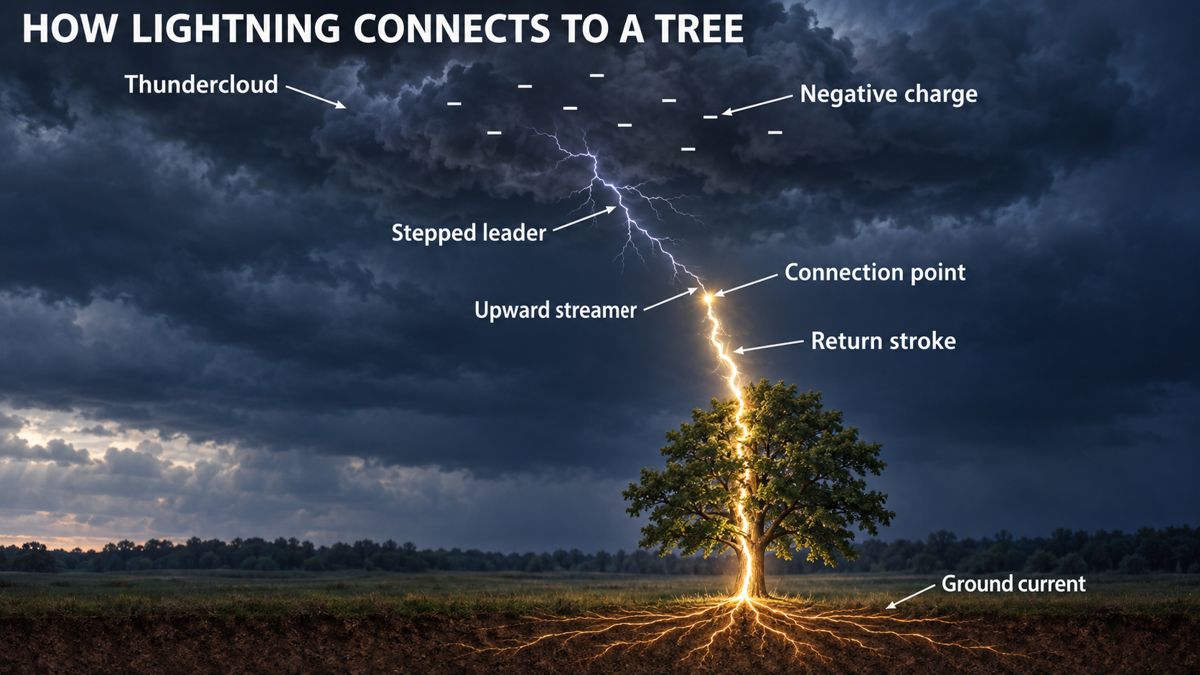
In the most common type of cloud-to-ground flash, a negatively charged channel develops downwards from the cloud in short, branching steps. This is called a stepped leader. It does not know where it will finally connect and responds mainly to the electrical field close to its tip.
When a branch comes to within roughly 50 metres of the ground or an object, upward streamers can develop from several objects below it. Taller, pointed and isolated objects are more likely to launch competitive streamers.
When one streamer connects with a descending branch, a conducting channel is completed. The bright return stroke then travels rapidly upwards through that channel.
This explains two important campsite facts:
- Metal does not attract lightning.
- Height, shape, isolation and the local electrical field influence where attachment occurs.
A metal tent pole, peg, caravan frame or braai grid does not call a strike out of the cloud. Metal is, however, an effective conductor. It can carry current if lightning strikes it, strikes something connected to it, or reaches it through the ground.
What about positive lightning?
Positive cloud-to-ground flashes are uncommon, accounting for roughly 10% or less of cloud-to-ground lightning. They usually develop from the upper positive-charge region of a thunderstorm, sometimes in the anvil away from the main rain shaft.
Positive flashes often transfer more electrical charge and may contain a longer continuing-current component than negative flashes. They can therefore cause serious damage and start fires. They may also occur 8 to 16 kilometres or more ahead of the main rain area.
This behaviour is not unique to South African thunderstorms. It is a general feature of lightning physics. There is good South African evidence for areas with high flash density and lightning risk, but insufficient evidence for the broader claim that South African lightning is generally more powerful than lightning elsewhere.
The safety lesson is simpler: do not use the position of the rain as the boundary of the danger area.
How lightning injures people at a campsite
A person does not have to receive a direct strike.
The main injury routes are:
- Direct strike: The main lightning channel attaches to the person.
- Side flash: Lightning strikes a tree, pole or other object and part of the current jumps to a nearby person.
- Ground current: Current spreads through the soil from the strike point and passes through a person’s body.
- Contact or conducted current: The person touches a fence, tent frame, electrical cable, plumbing system or another conductor carrying part of the current.
SAWS identifies ground current as the leading cause of lightning-related injuries in South Africa.
This is why lying flat on the ground is dangerous. It increases the distance between the body’s contact points and may expose the body to a greater voltage difference across the ground.
Is it safe to camp among trees?
Being directly under a tall or isolated tree during a thunderstorm is dangerous.
A tree may take a direct strike because of its height and isolation. Current can then jump sideways to a person, spread through the roots and surrounding soil, or travel through wet objects nearby. A strike can also strip bark, split timber and damage limbs. Strong thunderstorm winds add a separate falling-branch risk.
Tree positioning should therefore be considered when choosing the pitch, not after the storm has started.
If there is a choice between an exposed pitch beside one tall tree and a lower site among a group of shorter, similar-height trees, the second site generally presents less direct-strike exposure. However, inspect the canopy first. Do not pitch below dead branches, a leaning or diseased tree, or a large limb hanging over the caravan or tow vehicle.
This is only relative risk reduction. A tent among shorter trees does not become a lightning shelter. When thunder starts, move to proper shelter.
Tent, caravan or tow vehicle: which is safer?
| Location | Practical verdict | Reason and limitation |
|---|---|---|
| Substantial enclosed building | Preferred shelter | A solid reception building, restaurant or enclosed ablution block normally provides the best protection. Stay away from windows, doors, plumbing and plugged-in equipment. An open-sided lapa or picnic shelter is not suitable. |
| Hard-topped metal car, SUV or bakkie cab | Good campsite shelter | The outer metal body carries most of the current around the occupants. Close the windows and avoid touching metal connected to the exterior. The rubber tyres are not what protects you. |
| Fully enclosed steel or aluminium caravan or motorhome | Conditional | A continuous metal shell and frame can provide a Faraday-cage effect. Protection depends on the construction and is reduced by canvas sections, large non-metal sections and external electrical connections. Use the tow vehicle if the construction is uncertain. |
| Fibreglass or composite caravan | Do not rely on it | Fibreglass does not form a conducting enclosure around the occupants. A metal chassis alone does not prove that the living area is protected. Move to the tow vehicle. |
| Pop-top with canvas sides, tent, awning or gazebo | Unsafe | These structures do not provide lightning protection, even when they have metal frames. |
Official camping guidance regards a fully enclosed steel or aluminium recreational vehicle as potentially protective, while fibreglass and fabric-sided units are unsafe. A hard-topped metal vehicle remains the more certain choice when the caravan’s construction is unknown.
An aluminium-looking caravan should not automatically be treated as a safe metal enclosure. Many caravans use thin aluminium cladding with timber, foam, fibreglass sections, large windows and interrupted joints. Unless the manufacturer can confirm a suitably continuous metal enclosure, use the tow vehicle.
Prepare before thunder reaches the campsite
Most useful lightning precautions must be completed before the storm arrives.
- Check the SAWS forecast and warnings before leaving and again during the day, especially in the summer-rainfall region.
- Ask the campsite manager which solid buildings may be used during a thunderstorm.
- Keep the tow vehicle accessible, with its keys in a known place. Include children, older people, people with limited mobility and pets in the plan.
- Park away from dead branches, large overhanging limbs, power lines and places that may flood.
- Retract the awning and secure chairs, tables, braai equipment and loose poles early. This is mainly protection against wind, not because metal objects attract lightning.
- If thunderstorms are expected, switch off and disconnect the 230 V shore-power lead before thunder is heard, following the campsite and equipment manufacturer’s safe procedure.
- Lower external aerials and complete other outside work while conditions are still safe.
A nearby strike can travel through the campsite electrical system and into a connected caravan.
If thunder has already started, do not stand at the power pedestal to disconnect the cable. Do not go outside to save an awning. Move people to shelter. Equipment can be replaced.
What to do when you hear thunder
Do not wait for rain and do not wait for the flash-to-thunder interval to fall below 30 seconds.
The old 30/30 rule says to seek shelter when the gap between lightning and thunder is 30 seconds or less, then remain sheltered for 30 minutes after the last thunder.
A 30-second gap represents a strike roughly 10 kilometres away, which is already within a dangerous range.
Current SAWS and international guidance is clearer: the first audible thunder is the signal to enter safe shelter immediately. Remain there for at least 30 minutes after the last sound of thunder.
Once sheltered:
- Close vehicle windows.
- Avoid contact with exterior-connected metal, mains-connected equipment and cables.
- Do not shower, wash dishes or handle plumbing during the storm.
- A mobile phone operating on its own battery is safe to use. Do not use a corded telephone or a device connected to mains power.
- Stay sheltered for at least 30 minutes after the last thunder.
Lightning can travel through plumbing, electrical wiring and connected equipment. It can also occur well outside the main rain area.
If no safe shelter is available
There is no safe outdoor position during an active thunderstorm.
These steps can only reduce risk:
- Keep moving towards a substantial building or hard-topped metal vehicle if one is reachable.
- Leave hilltops, ridges, open ground and the water’s edge.
- Move away from isolated trees, large trunks, exposed roots, poles, fences and overhead power lines.
- In a forest, use lower terrain near shorter trees rather than the tallest trees, but do not stand against a trunk.
- Spread a group out so that one ground-current event is less likely to injure everybody.
- Never lie flat on the ground.
- If strikes are extremely close and there is genuinely nowhere to go, SAWS advises crouching low with the feet together and minimising contact with the ground. Treat this only as a last-resort position, not as protection.
If someone is struck
A lightning victim does not retain an electrical charge and is safe to touch.
Call emergency services immediately: 112 from a mobile phone or 10177 for an ambulance in South Africa.
Make sure the rescuer is not exposed to the continuing lightning threat. If the person is unresponsive and not breathing normally, start CPR and use an automated external defibrillator if one is available. Follow the emergency operator’s instructions and your level of training.
Anyone affected by lightning should receive urgent medical assessment, even if the person appears to recover quickly.
The campsite rule worth remembering
The best lightning plan is decided before the first flash:
- Identify a solid building or hard-topped metal vehicle.
- Prepare the caravan and awning before thunder begins.
- At the first thunder, move—do not wait for rain.
- Do not shelter in a tent, under an awning or beneath a tree.
- Remain sheltered for 30 minutes after the last thunder.
A well-positioned pitch can reduce exposure. It cannot turn a tent or unsuitable caravan into a safe lightning shelter.