
Removing Monkeys from Campsites: Hidden Ecological Costs
Removing monkeys from South African camping sites may seem like a simple fix for nuisance behaviour — stolen food, raided kitchens, or noise.
But such actions trigger complex ecological and social consequences that extend far beyond the boundaries of a campsite.
Monkeys are not invaders; they are part of an intricate natural system that humans often disrupt through careless behaviour. Eliminating them creates ecological vacuums, alters predator-prey balance, and invites new problems, including other monkey troops moving in to fill the gap.

Understanding Why Monkeys Visit Campsites
Monkeys around campsites, particularly vervet and samango monkeys, are not acting maliciously.
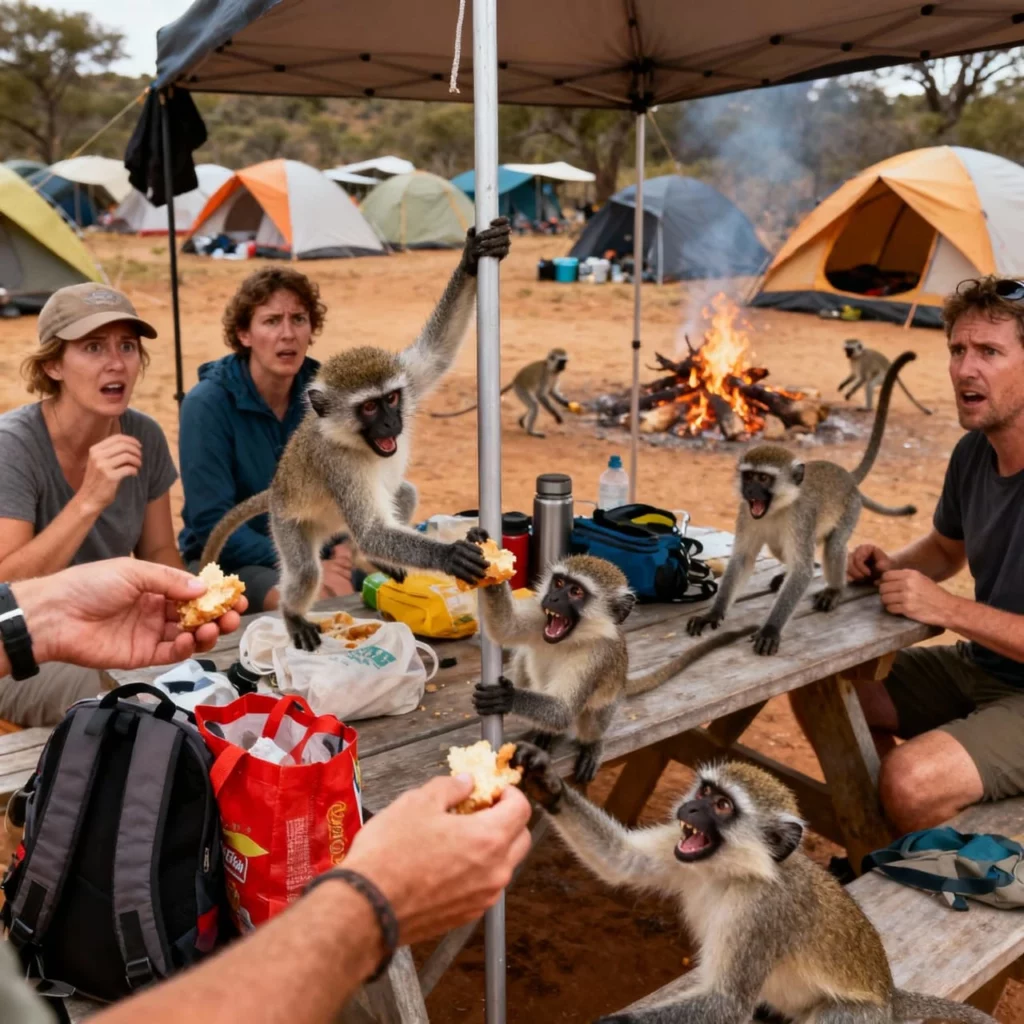
They exploit easy food sources created by humans — open bins, picnic leftovers, and unsecured supplies. Their boldness is learned behaviour, not natural aggression. When campers feed them, intentionally or not, it teaches them that human areas provide guaranteed food.
Over time, this changes troop behaviour and leads to human-wildlife conflict.
Viewing monkeys as “pests” ignores the root cause: human food waste and poor storage practices. As one conservation organisation notes, “They don’t hate campers or try to be destructive. They simply see campsites as reliable, easy sources of food.”
Ecological Roles of Monkeys and Consequences of Removal
Monkeys play multiple interconnected roles in maintaining healthy ecosystems. Removing them disrupts these roles, creating cascading effects that degrade both biodiversity and environmental stability.
| Ecological Role | Consequence of Removal |
|---|---|
| Seed Dispersal | Reduced Forest Regeneration: Seeds from fruiting trees fail to spread, leading to lower plant diversity and weaker forest resilience. |
| Prey–Predator Balance | Ecosystem Imbalance: Predators such as eagles, leopards, and pythons lose a food source, forcing dietary shifts and threatening smaller species. |
| Indicator Species | Loss of Early Warning: A decline in monkey populations signals habitat degradation and ecological stress, removing a natural monitoring system. |
| Nutrient Cycling | Soil Depletion: Droppings from monkeys enrich the soil with organic matter and spread beneficial microorganisms; their absence weakens nutrient cycling. |
| Tourism and Education | Economic Impact: Monkeys attract nature tourists. Their absence reduces the educational and recreational value of wildlife areas. |

Less Obvious and Far-Reaching Impacts
1. Accelerated Climate Change
Healthy forests act as carbon sinks, storing carbon dioxide and regulating local climates.
Monkeys are essential to forest regeneration through seed dispersal. When they disappear, the forests lose a key mechanism for self-repair and growth, weakening their carbon-storage capacity. Thus, primate loss contributes indirectly to climate change by reducing forest resilience.
2. Economic and Cultural Losses
Wildlife tourism is a major contributor to rural economies.
Monkeys — visible, social, and easy to observe — are key attractions. Removing them could decrease tourist visits and income for local communities.
For some indigenous cultures, monkeys also hold symbolic or spiritual importance, representing intelligence, balance, or ancestral presence. Their disappearance is not only ecological loss but cultural erosion.
3. Human Misperceptions
The “pest” label is entirely human-made.
Monkeys near campsites are reacting naturally to food availability. They do not grasp human concepts like ownership or property — a sandwich on a table is, to them, no different from a fruit in a tree.
Viewing their foraging as “theft” is a misunderstanding of animal instinct. The real issue is human negligence and habituation.
The Ecological Vacuum Effect
One of the least-discussed outcomes of removing monkeys is the vacuum effect — the ecological space left behind does not remain empty.
In ecosystems, every niche is filled. When one troop of monkeys is exterminated or relocated, another often moves in to exploit the same food sources.
This happens because:
- Neighbouring troops expand territory to access available resources.
- Young displaced males migrate into vacant areas to form new groups.
- Resource-rich environments, such as campsites with leftover food, remain irresistible attractants.
In short, killing or relocating one troop creates a temporary lull, but within months another troop usually replaces them. This turnover can even worsen conflict, as newcomers are unfamiliar with human boundaries and behave more aggressively or unpredictably.
Without addressing the attractants — open food, rubbish, and poor storage — the cycle continues indefinitely.
Hidden Ecological Consequences
1. “Edge Effect” Degradation
Campsites form ecological edges between human-modified and natural areas. Monkeys often transport forest seeds into these zones, maintaining vegetation diversity.
Removing them reduces this movement, allowing invasive or hardy species to dominate. Over time, forest edges recede, and biodiversity declines.
2. Predator and Prey Shifts
Predators dependent on monkeys, such as crowned eagles, may decline or turn to smaller animals like rodents and birds, disrupting those populations. This ripple effect — a trophic cascade — can transform entire local ecosystems over decades.
3. Displacement of Conflict
Eliminating monkeys from campsites does not solve the problem; it relocates it. The same individuals, or others, move to farms, resorts, or residential zones, starting new conflicts elsewhere.
This “conflict displacement” increases human frustration and often escalates into wider extermination campaigns.
4. Social Disruption and Stress
Monkeys are intelligent, social mammals with tight family structures. Removing a few individuals can destabilise entire troops, causing infighting, stress-related illness, and increased disease spread between groups.
5. Ecosystem Simplification
Removing monkeys simplifies local ecological networks.
Over time, such simplification — known as “defaunation” — leads to forests that look intact but function poorly. Fewer pollinators, altered nutrient cycles, and reduced resilience follow, ultimately threatening biodiversity.
Ethical, Social, and Conservation Considerations
- Legal Protections:
Most monkey species in South Africa are protected under conservation law. Unauthorised killing or trapping can violate wildlife regulations. - Public Perception:
Extermination of visible wildlife often leads to public outrage and negative publicity for tourism operators and conservation agencies. - Ethical Responsibility:
Monkeys possess complex cognition, emotions, and social bonds. Ethical wildlife management requires solutions that minimise suffering and maintain natural behaviour. - Cost and Sustainability:
Culling programs are expensive and rarely effective long-term. Managing human behaviour is cheaper and produces lasting results.
What You May Not Have Considered
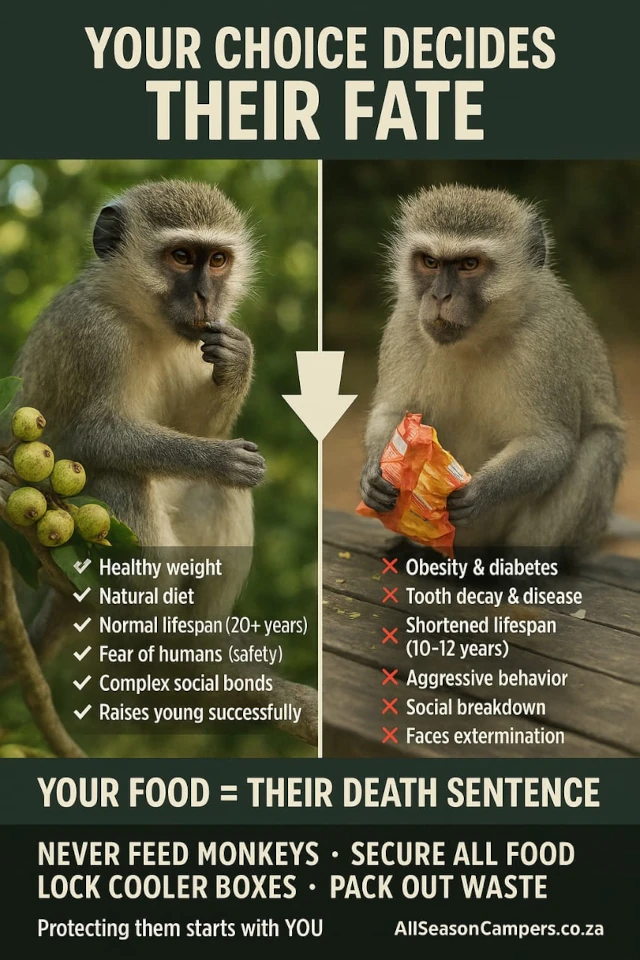
- Monkeys Do Not Understand Property: Food left out is perceived as part of the natural landscape. Expecting them to “respect ownership” misunderstands their instincts.
- Feeding Them Makes Things Worse: Once monkeys associate people with food, they lose natural wariness and become aggressive over time. Feeding is one of the main causes of future euthanasia or relocation.
- Coexistence Works: Securing food and rubbish in lockable containers or vehicles keeps monkeys wild and reduces conflict. Campers play a direct role in wildlife conservation by managing their own behaviour.
A Better Path Forward
The long-term solution lies not in extermination, but in behavioural change, coexistence, and proactive conservation.
1. Manage Human Behaviour
- Store food, toiletries, and rubbish in sealed, lockable containers.
- Never feed monkeys, intentionally or accidentally.
- Clean up eating areas immediately after use.
- Educate new campers on wildlife-safe practices.
2. Strengthen Waste Management
Install monkey-proof bins, reinforce lids, and remove waste daily. Campsites that manage food waste effectively report far fewer incidents of monkey raids.
3. Support Conservation and Education
Visiting and supporting sanctuaries such as Monkeyland in Plettenberg Bay helps fund rescue and education programs that teach respectful coexistence. These facilities often rehabilitate monkeys rescued from conflict zones or the pet trade.
4. Policy and Advocacy
Support local conservation policies that protect natural monkey habitats and promote sustainable land use. Encourage authorities to integrate non-lethal management plans into park operations.
5. Create Habitat Buffers
Planting indigenous vegetation around campsites creates natural separation zones, drawing monkeys away from human spaces while restoring ecological balance.
Conclusion
Monkeys near South African campsites are not intruders — they are native species responding to human behaviour.
Removing them disrupts seed dispersal, predator balance, and forest regeneration while creating vacuums that invite new troops to move in. The result is a self-perpetuating cycle of conflict, ecological decline, and social cost.
Real solutions come from responsible camping: secure food, manage waste, and respect wildlife boundaries.
Coexistence preserves not just the monkeys, but the integrity of South Africa’s natural ecosystems and the tourism economy that depends on them.