Caravan Nose Weight South Africa: Law and Measurement
Caravan nose weight (also called towball load or drawbar load) is the downward pressure a caravan or trailer applies to the vehicle’s towbar. Correct nose weight is critical for safe and stable towing in South Africa.
Legal caravan nose weight in South Africa
- The current law is the Compulsory Specification VC 8026 (2010).
- Clause 3.5.2 sets the static vertical load on the towball between 25 kg and 100 kg when the caravan or trailer is loaded.
- Your vehicle manufacturer and your towbar manufacturer may specify lower limits.
- The safe and legal value is always the lowest of:
- The law (25–100 kg),
- The vehicle manual,
- The towbar dataplate (S-value).
2011 proposal not yet in force
In 2011, Government Notice R.597 (Gazette 34463) proposed amendments to VC 8026.
- It repeated the 25–100 kg rule and introduced technical updates.
- It has not been adopted.
- The 2010 version of VC 8026 remains in force.
Caravan categories (O1 to O4)
Caravans and trailers are classified internationally and in South Africa by Gross Vehicle Mass (GVM):
- O1: GVM ≤ 750 kg. No brakes required. Examples: small luggage trailers, micro caravans.
- O2: 751–3 500 kg. Overrun or service brakes required. Includes most touring caravans.
- O3: 3 501–10 000 kg. Heavy-duty trailers with air or hydraulic brakes. Rare for camping use.
- O4: >10 000 kg. Industrial or freight trailers, not recreational caravans.
Licence requirements
- Code B licence: allows towing O1 trailers only.
- Code EB licence: required to tow O2 caravans up to 3 500 kg.
- O3 and O4: require a heavy vehicle licence.
Why nose weight matters
- Too little (<25 kg) → caravan sway (snaking), high accident risk.
- Too much (>100 kg or above limits) → rear axle overload, front of vehicle lifts, steering and braking compromised.
- Correct nose weight ensures stability, shorter braking distance, and reduced wear on towbar and suspension.
How to measure caravan nose weight
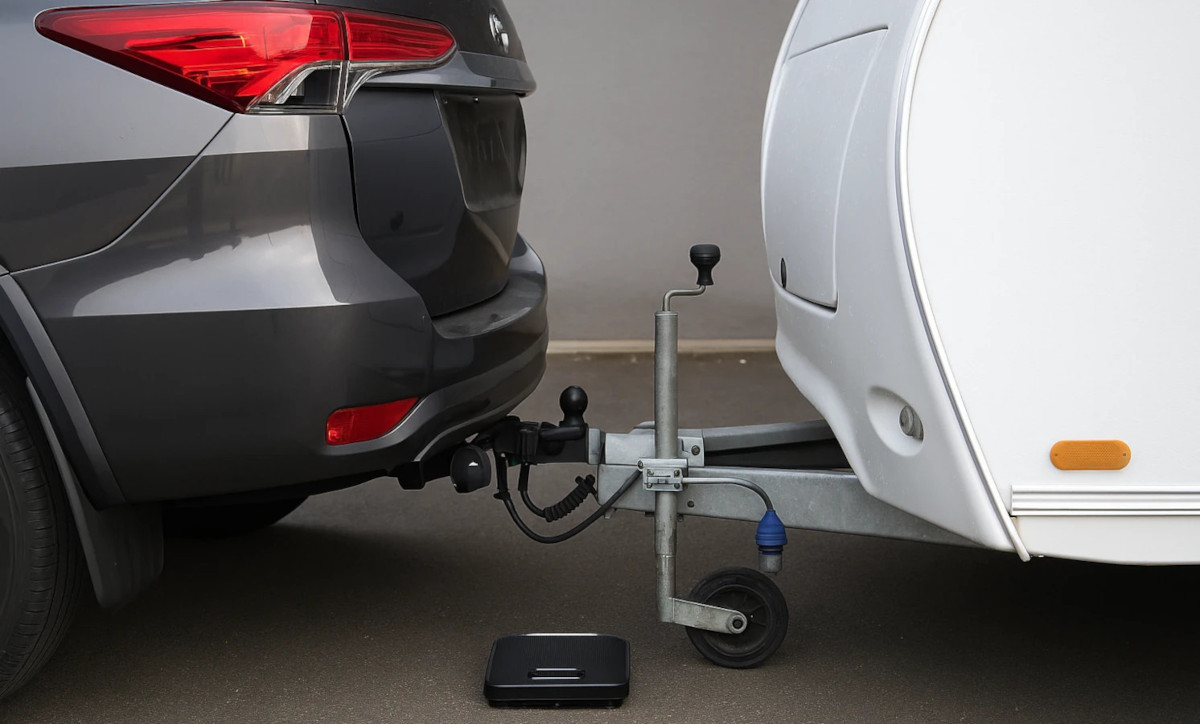
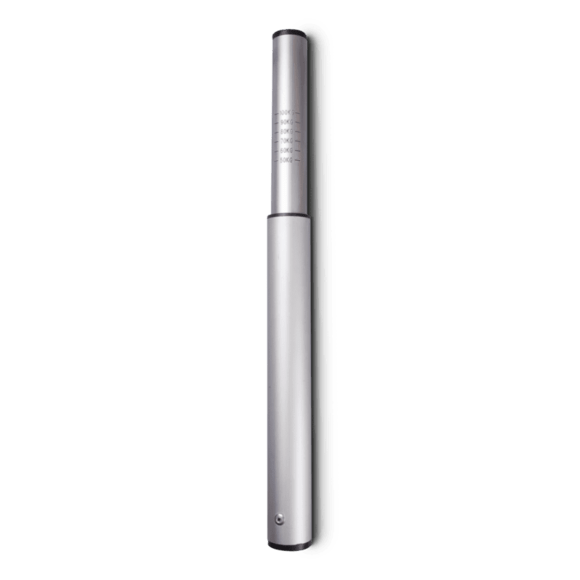
The easiest way is with a caravan nose weight gauge. If you don’t have one, use a bathroom scale.
What you need
- Bathroom scale (digital or mechanical).
- Flat, hard surface.
- Caravan with jockey wheel.
Step-by-step guide
- Find your target: Check the caravan’s GVM. Calculate 5–10% (ideal = 7–9%).
- Set up: Park on level ground and load caravan as for travel.
- Place scale: Put bathroom scale under jockey wheel.
- Lower wheel: Rest jockey wheel firmly on the scale, with coupling clear of the ground.
- Read value: This is the caravan’s nose weight.
- Compare: Check it is between 25–100 kg and below the vehicle/towbar limit.
- Adjust load:
- Too light → move heavy items slightly forward.
- Too heavy → move items back, but never against the rear wall.
Accuracy tips
- Measure with the hitch at the same height as your towball.
- Repeat 2–3 times and take the average.
- Only the jockey wheel should press on the scale, never by hand.
Examples of caravans and typical nose weights
| Model | GVM (kg) | 7–10% theoretical (kg) | Legal context (25–100 kg rule) |
|---|---|---|---|
| Jurgens Penta | 1 380 | 97–138 | Can exceed 100 → keep ≤100 kg |
| Quantum Comfort | 1 660 | 116–166 | Above 100 → restrict to 100 kg |
| Destination Journey | 2 400 | 168–240 | Far above 100 → stabiliser essential |
| Sprite Scout | 1 100 | 77–110 | May exceed 100 → stay under limit |
| Sherpa | 1 250 | 87–125 | Often >100 → pack carefully |
The 7–10% rule vs. South African law
- International guideline: nose weight = 7–10% of caravan GVM.
- Problem in SA: large caravans would exceed 100 kg.
- Legal requirement: VC 8026 caps nose weight at 100 kg maximum.
👉 Use the 7–10% rule only as a stability guide. Always comply with the lowest of the three limits:
- Law (25–100 kg),
- Vehicle manual,
- Towbar S-value.
Final checks before towing
- Nose weight 25–100 kg and below all limits.
- Tyre pressures correct (car and caravan).
- Lights, mirrors, and safety chain checked.
- Stabiliser or anti-sway device fitted if required.
- Headlights adjusted (heavy nose weight can lift beams).
FAQ: Caravan Nose Weight South Africa
Q: What is the legal caravan nose weight?
A: VC 8026 (2010) sets the limit at 25–100 kg for O1 and O2 caravans.
Q: Is the 2011 amendment in force?
A: No. The 2011 proposal (R.597) has not been adopted. The 2010 law remains valid.
Q: What do O1 and O2 mean?
A: O1 = trailers ≤750 kg GVM (no brakes). O2 = 751–3 500 kg with brakes. O3/O4 = heavy trailers, not recreational caravans.
Q: My car manual says 75 kg. What applies?
A: Always follow the lowest limit between law (100 kg), vehicle, and towbar.
Q: Why is nose weight important?
A: Too light = sway. Too heavy = rear axle overload, unstable steering, poor braking.
Q: How do I measure at home?
A: Lower the jockey wheel onto a bathroom scale or use a nose weight gauge.
✅ Summary: In South Africa, caravan nose weight is legally set at 25–100 kg for O1 and O2 caravans under VC 8026 (2010). The 2011 amendment has not been adopted. Always respect the lowest limit between law, vehicle, and towbar.